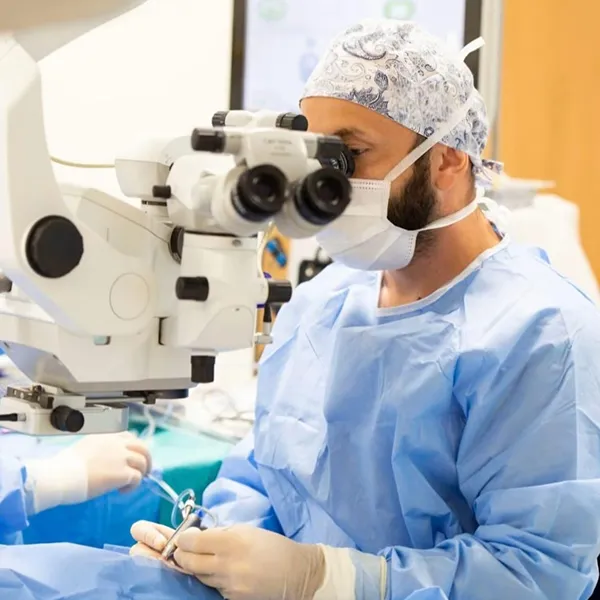
Cataract surgery removes the clouded natural lens and replaces it with an artificial intraocular lens (IOL). The same operation is also the most effective surgical correction of refractive error – myopia, hyperopia, astigmatism and, with the right lens, presbyopia.
Refractive lens exchange (RLE) is the same procedure performed in people without a cataract who want to be permanently free of glasses. For many patients over 45 it is a better and more complete alternative to laser vision correction.
What the procedure involves
The operation is performed under topical (eye-drop) anaesthesia as a day case. Through a micro-incision in the cornea the natural lens is removed by phacoemulsification (ultrasound) and a foldable intraocular lens is implanted. Surgery itself usually takes around fifteen minutes and you go home the same day.
The second eye is operated on after an interval agreed with your surgeon, once the first eye has been checked.
Types of intraocular lenses
- Monofocal aspheric – sharp vision at one distance (usually far); reading glasses are needed.
- Toric – additionally corrects corneal astigmatism; available in monofocal, EDOF and trifocal versions.
- EDOF (extended depth of focus) – sharp from far to intermediate distance (computer, dashboard) with a low risk of visual side effects.
- Trifocal – three focal points: far, intermediate and near; the greatest independence from glasses.
OKUMED offers leading trifocal implants, including ZEISS AT ELANA, Alcon Clareon PanOptix Pro and Bausch + Lomb enVista Envy.
Qualification – the most important step
The lens stays in the eye for life, so we treat its selection as a separate, fully fledged stage of treatment. During the qualification visit we perform precise biometry, corneal topography and aberration analysis (spherical aberration, coma, angle kappa), assessment of the ocular surface and tear film, and a fundus examination with macular OCT.
On this basis we determine whether your eye is suitable for a multifocal lens, whether toric correction is needed and which lens model will give the best result for your lifestyle.
Complication repair and secondary implants
Dr Mateusz Ślizień also repairs complicated cataract operations, performs secondary lens implantation and glaucoma surgery.
Private or public (NFZ)?
In Poland cataract surgery is available through the public health fund (NFZ) or privately. Public surgery is free of charge, but the date depends on the queue at a given hospital and a standard monofocal lens is implanted; under the public scheme a toric lens is used only for astigmatism above 2.0 D, so after surgery glasses may be needed for distance as well as for reading. Toric lenses matched to any degree of astigmatism, and EDOF and trifocal lenses, are available only in private surgery.
At OKUMED we operate privately: the date is agreed individually within the coming weeks, qualification includes full diagnostics (biometry, corneal topography and aberrometry, OCT) and the lens is matched to your eye and lifestyle. The price depends on the lens – from PLN 4,000 per eye (monofocal) to PLN 9,000–10,000 (trifocal toric). The first post-operative check-up is free of charge; the exact scope of care included in the price is discussed at qualification.